WhatsApp is excellent when both people use WhatsApp. It becomes less useful when the number belongs to a hotel front desk, government office, clinic, airline, restaurant, supplier, or family landline that is not available as a WhatsApp contact.
In that situation, you do not need another messaging app. You need an internet-to-phone service: the caller uses a browser or app, while the recipient answers an ordinary landline or mobile call.
The best WhatsApp alternatives for calling landlines abroad are Localcall, Viber Out, Talk360, and Google Voice. They solve different versions of the same problem. Localcall is the strongest fit when you want to call from a browser, see the destination rate before connecting, add live translation, or send an AI phone agent. Viber Out and Talk360 are app-based choices for calls to ordinary numbers. Google Voice can fit eligible users who already have a Google Voice setup.
Before choosing, answer four questions:
- Does the service reach ordinary landlines and mobiles?
- Does the recipient need the same app?
- Can you see the exact destination rate before calling?
- Do you need live translation, an AI agent, or only a direct voice call?
Use the Localcall phone validator to check the number format, the cost calculator to estimate the call, and the best-time planner to avoid calling outside local business hours.
Quick comparison
| Option | Reaches ordinary landlines and mobiles? | Recipient needs the same app? | Caller experience | Best fit |
|---|---|---|---|---|
| Localcall | Yes | No | Browser | International calls with live translation or AI-agent help |
| Viber Out | Yes, subject to destination and number restrictions | No | Mobile or desktop app | People already comfortable with Viber credit or plans |
| Talk360 | Yes | No | Mobile app | App-based pay-as-you-go international calling |
| Google Voice | Yes, for supported destinations and eligible accounts | No | Web or mobile app | Users who already have a Google Voice number and account |
| Carrier international calling | Usually | No | Native phone dialer | Occasional calls when the carrier rate is acceptable |
| Calling card | Usually | No | Access number and PIN | A fallback when internet calling is unavailable |
Rates, destinations, account eligibility, and number restrictions change. Check the live quote for the exact country and line type before adding credit or starting an important call.
Why a normal WhatsApp call may not solve the problem
WhatsApp consumer calls happen inside the WhatsApp calling experience. They are ideal when the other person is a WhatsApp user with internet access. They are not a general replacement for the public phone network.
That distinction matters because many essential numbers are still ordinary phone endpoints:
- A hotel front desk.
- A restaurant reservation line.
- A clinic or pharmacy.
- A school or local government office.
- An airline or railway support desk.
- A bank or insurance service number.
- A supplier, warehouse, or field office.
- A relative's home landline.
If the destination is one of those numbers, look for a service that explicitly connects to landlines and mobiles. The recipient should be able to answer without installing anything.
1. Localcall: best for browser calls, translation, and AI-agent help
Localcall is built around the phone-number workflow. Open the browser dialer, enter the international number, check the route and price, then choose how the call should run:
- Direct calling when both people share a language.
- Live translation when each person speaks a different language.
- An AI phone agent for a narrow, routine task.
The recipient does not need Localcall, a smartphone, or an internet connection. They answer through their ordinary landline or mobile provider.
This makes Localcall useful for calls that start with a practical task rather than a social contact:
- Confirm a hotel reservation in Spanish.
- Ask a restaurant about allergy accommodations.
- Call a supplier about opening hours or stock.
- Reach a family landline in the Philippines.
- Ask a local office which documents to bring.
- Use an AI agent to confirm a simple appointment window.
The main advantage over a standard app-to-app call is not merely reach. It is the combination of phone-network reach, browser access, number tools, live translation, and AI-agent calling in one flow.
Use international calls to browse the calling workflow, or open the dialer when you already have the number.
2. Viber Out: best for people already using Viber
Viber Out is separate from a normal Viber-to-Viber call. It connects calls from Viber to ordinary phone numbers. Viber documents support for landline and mobile numbers through World Credit or calling plans, with restrictions for special, premium, non-geographic, and satellite numbers.
The recipient does not need Viber or internet access. The caller does need Viber, an internet connection, and an active credit balance or plan.
Viber Out fits when:
- You already use Viber on mobile or desktop.
- You prefer a credit or country-plan model.
- You do not need built-in live phone-call translation.
- You have checked that the destination and number type are supported.
The pricing model deserves attention. Viber offers several products, and its support documentation notes that rates can change. Check whether the offer is a monthly plan, a minute bundle, or World Credit, and confirm how calls are rounded before buying.
3. Talk360: best for app-based pay-as-you-go calling
Talk360 describes its service as online-to-offline calling. The caller uses Wi-Fi or mobile data, and the recipient answers a regular mobile or landline call without Talk360 or internet access.
Talk360 fits when:
- You want a mobile-app dialer.
- You want a pay-as-you-go credit model.
- The recipient has only a basic phone or landline.
- You do not need incoming calls, messaging, or a virtual number.
Talk360 says rates vary by destination, line type, provider, and account currency. It also recommends entering numbers in full international format. Check the quote for the exact number rather than comparing only a country's lowest advertised rate.
4. Google Voice: best for eligible users already in its ecosystem
Google Voice supports domestic and international calls from web and mobile. International calls use listed rates, and Google advises users to confirm that the call is actually routed through Google Voice so a mobile carrier does not apply unexpected charges.
Google Voice fits when:
- You already have an eligible Google Voice number and account.
- You want calling, voicemail, and number management in the same product.
- Your destination is supported.
- You understand whether the call is using internet calling or carrier minutes.
Account availability is the main constraint. Personal Google Voice remains centered on US users, while business availability depends on the subscription and region. It is a sensible option for existing users, but it is not the most direct starting point for every traveler or international caller.
5. Carrier international calling and calling cards
Your mobile or landline carrier can usually place the call without another app. The tradeoff is price visibility. International rates, connection fees, roaming rules, and plan add-ons can make a short call unexpectedly expensive.
A calling card can also reach ordinary numbers. It may be useful when internet access is unreliable, but the workflow can involve an access number, PIN, expiration policy, connection fee, or minute rounding.
Use either option only after checking the complete price structure. A low headline rate is not useful if the call includes a connection fee, short credit expiry, or aggressive rounding.
How to choose the right alternative
Choose Localcall when:
- You want to call directly from a browser.
- You need live translation for the conversation.
- You want an AI agent to make a routine call.
- You want number validation, rate visibility, and calling in one workflow.
Choose Viber Out when:
- You already use Viber.
- A Viber plan or credit product fits your calling pattern.
- You need landline reach but not translation or AI-agent calling.
Choose Talk360 when:
- You prefer a mobile pay-as-you-go app.
- The recipient does not use calling apps.
- You only need outbound international voice calling.
Choose Google Voice when:
- You already have an eligible account.
- You want to call from an existing Google Voice number.
- Its destination rate and routing fit the call.
Choose your carrier or a calling card when:
- Internet calling is unavailable.
- You have confirmed the complete rate and fee structure.
- The simpler native-phone workflow is worth the cost.
How to format an international landline number
Most internet calling services expect the full international number:
- Start with the plus sign.
- Add the destination country code.
- Add the area or city code.
- Add the subscriber number.
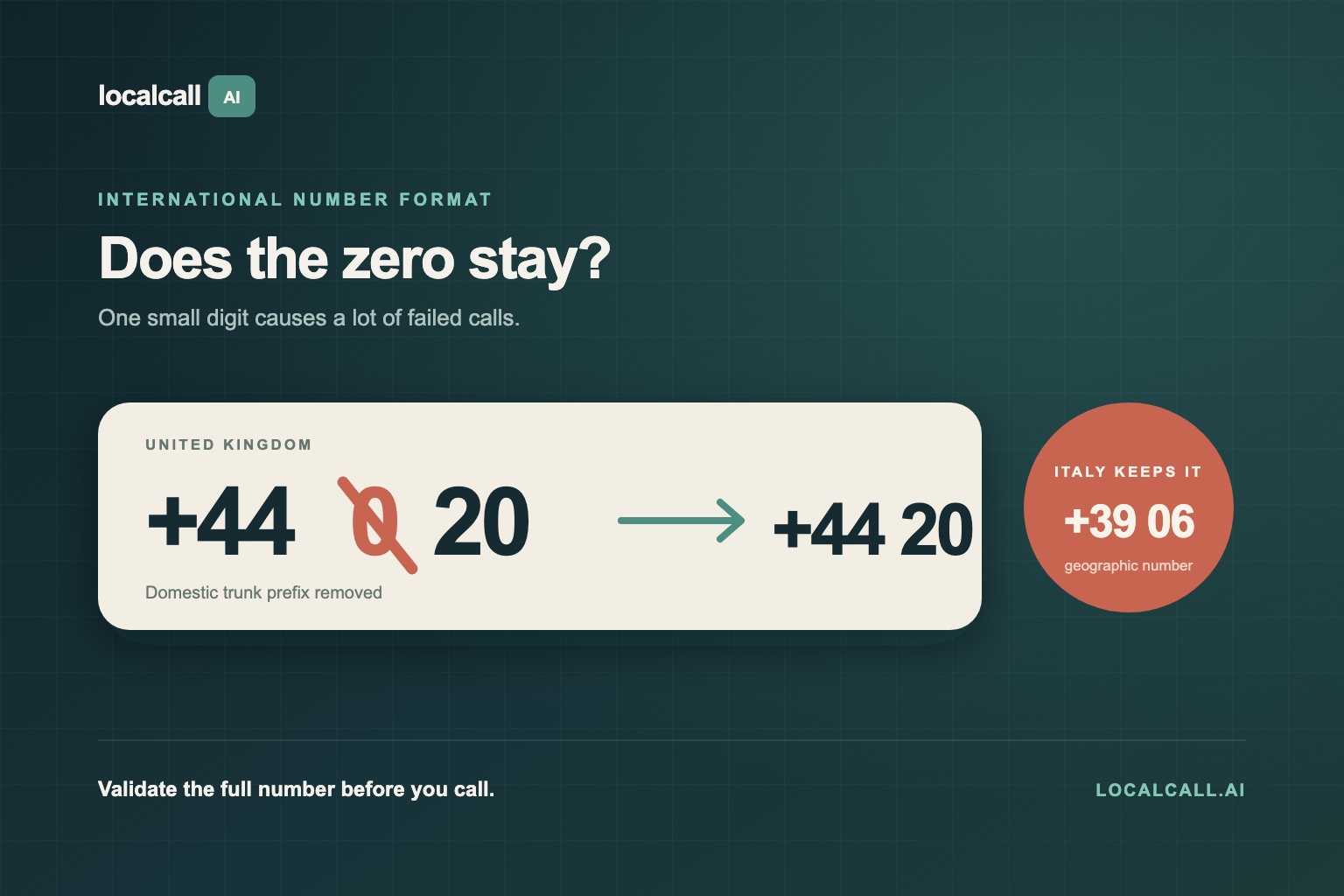
- Remove a domestic leading zero when the country's rules require it.
For example, a local number may be written with a leading zero inside its home country but require that zero to be removed after the country code. Do not guess when the call matters. Use the phone validator and the relevant how-to-call guide first.
If you are calling Mexico, review how to call Mexico. For the Philippines, use the Philippines calling guide. Both include number-format guidance and practical phrases for the call.
When live translation changes the choice
Reaching the landline is only half the problem when the person answering speaks another language.
A standard calling app connects the audio. A live-translation calling service also handles the language layer: it listens to one speaker, transcribes the sentence, translates it, and speaks the translated version to the other side. The process repeats in both directions.
Use short sentences and pause after complete thoughts. Confirm names, dates, addresses, prices, and reference numbers slowly. For emergencies or high-stakes legal, medical, immigration, banking, or financial decisions, use qualified human help when required.
Read how live phone-call translation works before your first translated call.
When an AI phone agent changes the choice
Some landline calls are necessary but repetitive. You may only need to ask whether a restaurant has a table, whether a hotel accepts late check-in, whether a store has an item, or whether an office is open on a holiday.
That is a better fit for a bounded AI phone agent than an open-ended conversation. Give the agent one goal, the necessary details, acceptable fallback options, and clear stop conditions. Do not authorize it to make payments, disclose sensitive information, or make legal, medical, or financial decisions.
Use the AI call-agent setup guide to define the task before dialing.
Final answer
WhatsApp remains the easy choice when both people are available inside WhatsApp. When the destination is an ordinary international landline or mobile number, choose a service that explicitly reaches the phone network.
Use Localcall when the call needs browser access, live translation, or AI-agent help. Use Viber Out or Talk360 when you prefer an app-based credit workflow. Use Google Voice when you already have an eligible account. Use a carrier or calling card only after checking the full cost.
To place the call, validate the number, estimate the cost, then open Localcall live translation or the browser dialer.