A toll-free number can be free at home and unreachable the moment you cross a border. That is not necessarily a formatting mistake. 1-800, 0800, 1800, and +800 are different numbering systems, and most domestic toll-free services are controlled by the country, carrier, and organization receiving the call.
The reliable solution is to identify which kind of number you have, try the correct international format once, and then switch to the organization's ordinary geographic number if the toll-free route fails. Do not keep trying random prefixes: you can create charges without making the number any more reachable.
The quick answer
| Number shown | What it usually means | What to try from abroad |
|---|---|---|
| 1-800, 1-888, 1-877, 1-866, 1-855, 1-844, or 1-833 | North American toll-free number | Try +1 followed by all 10 digits, but expect possible blocking or charges |
| 0800 or 0808 in the UK | UK domestic Freephone number | Look for the organization's geographic +44 alternative |
| 1800 in Australia | Australian domestic freephone range | Look for the organization's +61 geographic alternative |
| +800 followed by eight digits | Universal International Freephone Number, or UIFN | Dial +800 and the eight digits; availability still depends on participating networks |
| A number labeled “toll-free” with no country | Ambiguous domestic number | Identify the country before dialing anything |
If the call concerns a bank, airline, insurer, government office, or travel booking, open the organization's official website or app and search for “calling from abroad,” “international contact,” or “outside [country].” That page is more useful than a generic number directory because it reflects the department's current routing.
Why toll-free numbers often fail internationally
“Toll-free” describes who pays for a call under a particular service arrangement. It does not mean every phone network in the world must carry the call.
A domestic freephone number is normally attached to a national numbering plan. The organization receiving the call chooses a carrier and coverage arrangement, and that arrangement may accept calls only from approved networks or locations. When you call from another country, several things can go wrong:
- the receiving business has not enabled international origination;
- your carrier does not route that foreign toll-free range;
- the number is recognized, but the call is charged as an international call;
- a roaming network, hotel switchboard, corporate phone system, or VoIP provider blocks special-service numbers;
- the number was published without its country context, so the digits point somewhere else;
- the organization wants overseas callers to use a separate geographic or collect-call number.
This is why a toll-free number can work from a local SIM but fail on a foreign SIM in the same room. The visible number is only one part of the route.
How to call a US toll-free number from abroad
US and Canadian toll-free numbers sit inside country code +1. The FCC recognizes the familiar 8YY codes: 800, 888, 877, 866, 855, 844, and 833. Each is followed by seven digits.
To try the number internationally:
- Remove spaces, parentheses, and hyphens.
- Add +1 before the ten-digit toll-free number.
- Keep the toll-free code. Do not remove the first digit of 800, 888, or another 8YY code.
- Place one test call and listen to the exact error message.
For example, a number printed as 1-800-XXX-XXXX becomes +1 800 XXX XXXX. The plus sign replaces the international exit code on most mobile phones. From a landline, you may need the local exit code instead.
Correct formatting does not guarantee that the call will connect or remain free. The strongest evidence is the organization's own contact instructions. The US Department of State, for example, publishes one toll-free number for callers in the United States and Canada and a separate +1 geographic number for callers elsewhere. That pattern is common because the geographic number can be routed as a normal international call.
How to call a UK 0800 or 0808 number from abroad
Ofcom classifies 0800 and 0808 as UK Freephone ranges and says they are free for UK consumers calling from mobile or landline phones. Ofcom also explicitly separates those domestic rules from international calls and calls made while roaming overseas.
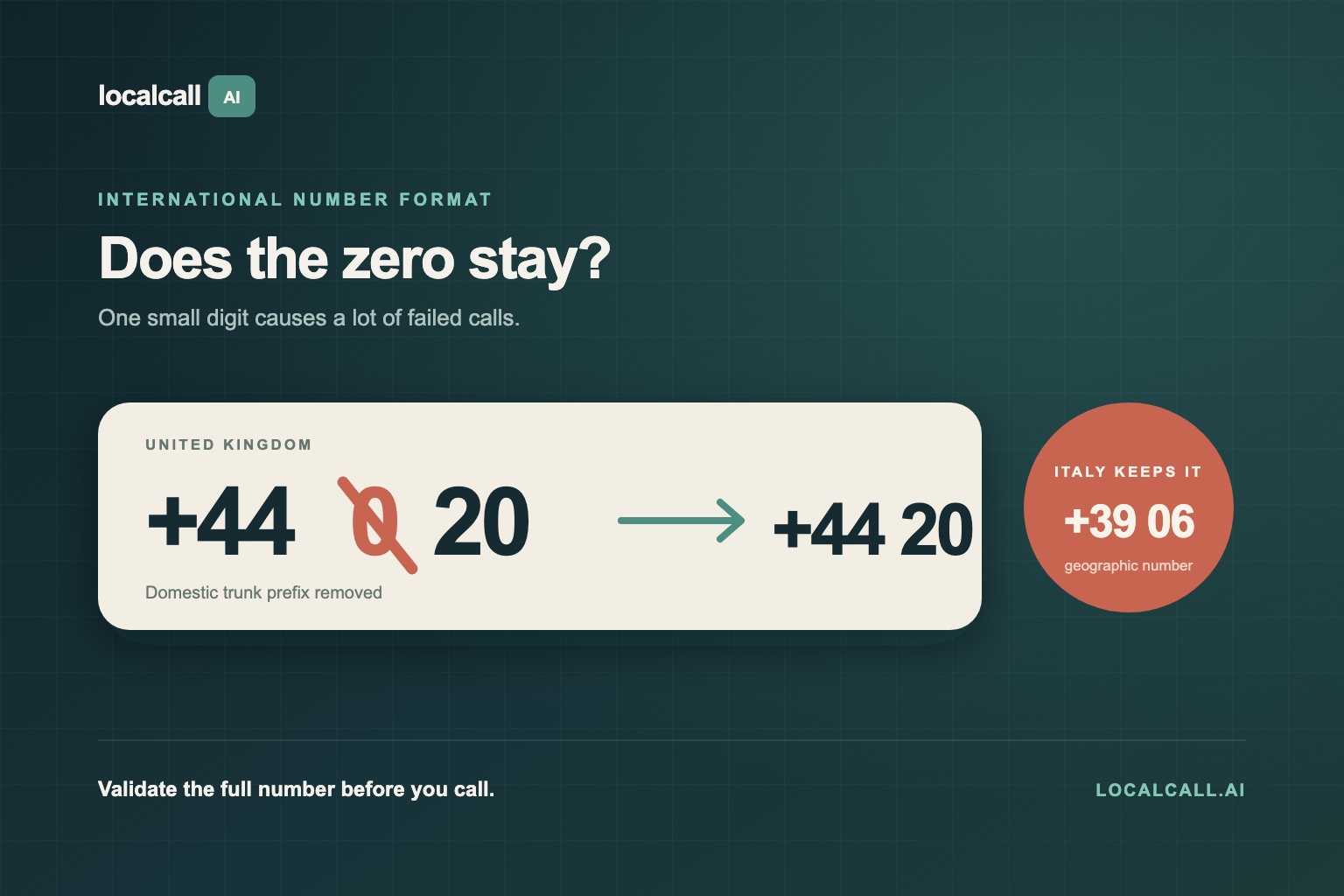
Adding +44 is worth trying only when the organization says the number accepts overseas calls. If it does, the domestic leading zero is normally removed: 0800 ... becomes +44 800 .... Your carrier may still reject or charge for the call.
The better fallback is an ordinary UK geographic number. Look for a number beginning with 01 or 02 in domestic format, then convert it to +44 and remove the initial zero. Confirm that it reaches the same department before sharing account information.
How to call an Australian 1800 or 1300 number from abroad
Australia uses 1800 for freephone services and 13/1300 for local-rate services. Australia's communications regulator notes that charges depend on the service and phone plan; those domestic arrangements do not turn the number into a universally free international destination.
If the company lists an overseas number, use that instead. An Australian geographic number can be written in full international format as +61, followed by the area code and subscriber number without the domestic leading zero. A business may also publish a dedicated number for callers outside Australia.
Do not assume 1300 and 1800 are interchangeable. They are different service types, and a provider that routes one may reject the other.
What +800 actually means
+800 is not the international spelling of every 800 number. It is a separate global service code assigned by the International Telecommunication Union for Universal International Freephone Numbers.
The ITU specifies a fixed format: country code 800 followed by an eight-digit Global Subscriber Number. A complete UIFN therefore looks like +800 1234 5678. The subscriber must arrange service in at least two countries, but that still does not mean every carrier, hotel phone, PBX, or calling app will route it.
Compare the structures:
- US toll-free: +1 800 XXX XXXX
- UIFN: +800 XXXX XXXX
The space after +1 is not cosmetic. +1 is the North American country code; +800 is the global-service code. If you turn +1 800 into +800, you are dialing a different number.
The most reliable workaround: find the geographic number
When a toll-free number fails, stop treating the prefix as the problem to solve. Find another published route to the same organization.
1. Use the official contact page
Search the organization's official domain for:
- “international contact number”;
- “call from overseas”;
- “outside the United States,” “outside the UK,” or the relevant home country;
- the exact department name plus “phone”;
- accessibility, fraud, lost-card, or emergency travel contact details when relevant.
Avoid copying a number from an unsourced directory, search snippet, forum post, or social account. Phone numbers change, and a convincing wrong number is a serious phishing risk.
2. Check documents you already trust
Banks, insurers, airlines, and card issuers often print an international or collect-call number on:
- the back of a payment or membership card;
- a recent statement or policy document;
- the signed-in mobile app;
- a booking confirmation;
- the help screen attached to the relevant transaction.
Using a signed-in surface also reduces the chance that you call an impersonator.
3. Convert the geographic number to international format
Start with the plus sign, add the country code, then add the national number with any removable domestic trunk prefix omitted. The exact rule varies by country.
Use Localcall's phone number validator to check the country, line type, and normalized format before dialing. If you need country-specific steps, open the international calling guide directory or the exact origin-to-destination corridor.
4. Confirm cost and opening hours
A geographic alternative is normally billable even when the original number was toll-free. Check the rate before connecting and use the best-time-to-call tool so you do not spend money waiting through a closed-office recording.
Can you use a browser calling service?
A browser-to-phone service can be useful after you find a supported ordinary landline or mobile number. It avoids cellular roaming for the outbound leg and lets you see the per-minute quote before calling.
With Localcall, enter the full international number and review the destination and displayed rate. The number validator and quote are the eligibility check. Localcall screens destinations and does not promise support for toll-free, premium, emergency, satellite, or other special-service ranges.
If the organization gives you a geographic alternative, you can place that call from the browser dialer. When language is the next barrier, live call translation can translate a supported browser-to-phone call while the organization answers on its ordinary phone line.
Localcall is outbound-only and is not an emergency-calling service. Do not use it for police, fire, ambulance, coast guard, or another emergency service.
A safe checklist for banks, airlines, and government offices
Toll-free failures often happen during stressful calls. Use this order:
- Verify the organization and department on its official domain or signed-in app.
- Find the number specifically labeled for callers outside the home country.
- Check whether the organization offers secure in-app messaging or callback.
- Save the geographic number in full international format.
- Confirm the local opening time and likely call cost.
- Never give a one-time password, full PIN, or remote device access to someone who called you unexpectedly.
- If the number concerns an emergency, use official local emergency channels instead of an internet calling service.
For a payment card, the number printed on the physical card or shown inside the issuer's signed-in app should take priority over a search result. For a government office, use the department's official country domain and confirm whether the line is intended for international callers.
What each failure message tells you
| What happens | Likely meaning | Next step |
|---|---|---|
| “Number unavailable from your calling area” | International origin is blocked | Find the published overseas or geographic number |
| “Number not in service” only when abroad | Your carrier cannot route the special range | Try the organization's geographic number through another supported provider |
| The call connects but is not free | Domestic toll-free pricing does not apply | End the call if the rate is unacceptable and use a quoted alternative |
| A browser dialer rejects the number | The service range is unsupported or screened | Do not alter the digits; use a verified geographic number |
| An unexpected person asks for credentials | The number may be wrong or compromised | Hang up and restart from the official website, card, statement, or app |
The rule to remember
Toll-free is usually a domestic billing promise, not a universal routing promise. Format the number correctly, try it once, and believe the network when it says the route is unavailable.
The dependable path is the organization's official international or geographic number. Verify it, convert it to full international format, check the rate and local time, then call through a supported carrier or browser-to-phone service.
Sources and further reading
- International Telecommunication Union: Universal International Freephone Numbers
- ITU-T Recommendation E.169.1: Universal international freephone numbering
- Federal Communications Commission: 8YY toll-free codes
- Ofcom: UK Calling and Freephone ranges
- Australian Communications and Media Authority: Call charges from landlines
- US Department of State: Communicating while abroad