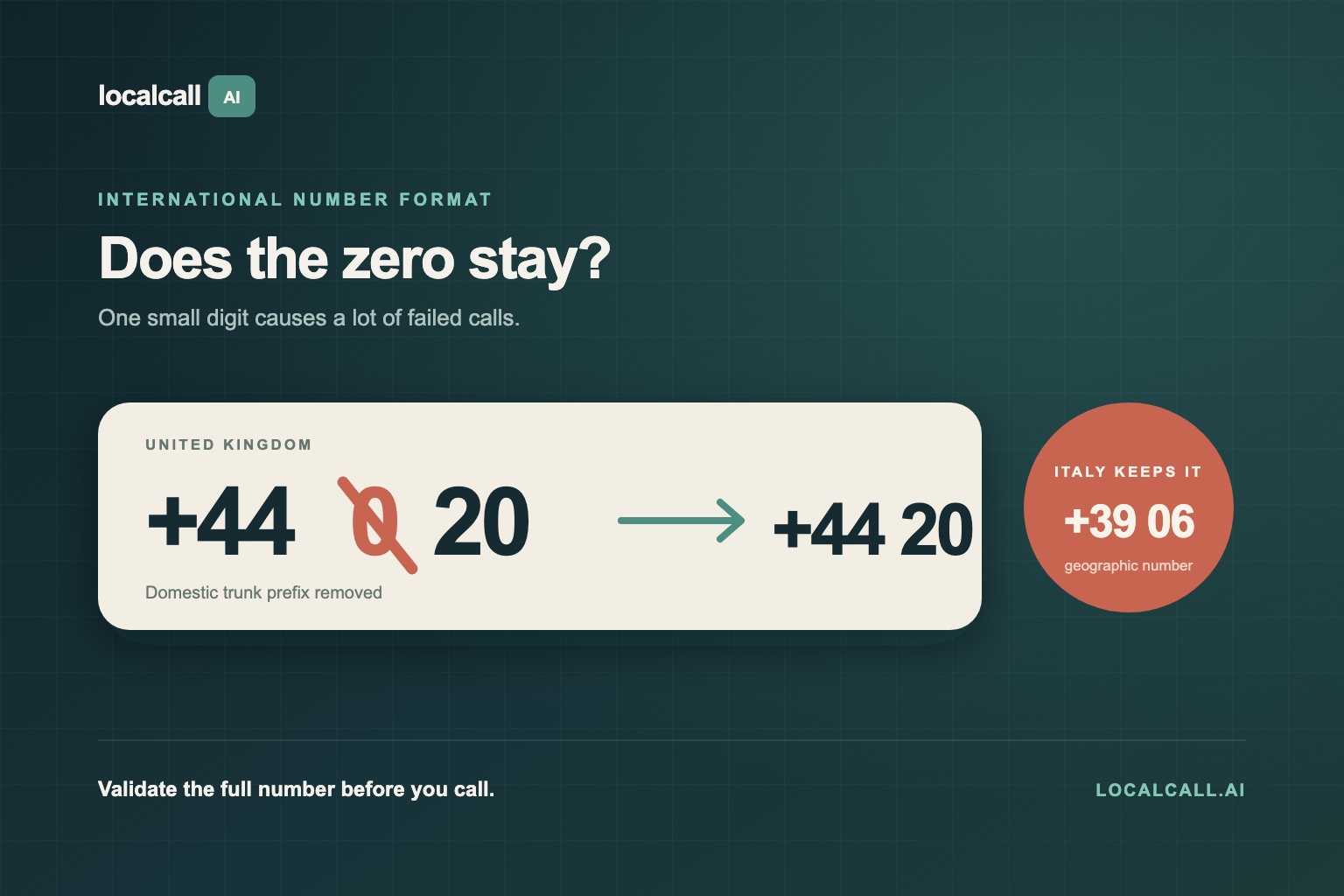
Most countries drop a domestic leading zero when you add the country code. A UK number written as 020 ... becomes +44 20 .... A German number written as 030 ... becomes +49 30 ....
The zero is often a trunk prefix used only for calls inside that country. The International Telecommunication Union says the destination country's trunk prefix should not be dialled in international service.
There are exceptions. Italian geographic numbers keep the zero, so a Rome landline begins +39 06 ..., not +39 6 .... The safe rule is to remove a zero only after confirming that it is a trunk prefix.
Quick answer by country
These examples show the area or mobile prefix only. The dots stand for the remaining subscriber digits.
| Country | Number written for domestic use | International format | What happens to the 0? |
|---|---|---|---|
| United Kingdom | 020 ... | +44 20 ... | Remove it |
| Germany | 030 ... | +49 30 ... | Remove it |
| France | 01 ... | +33 1 ... | Remove it |
| Australia | 02 ... | +61 2 ... | Remove it |
| Japan | 03 ... | +81 3 ... | Remove it |
| Italy, geographic number | 06 ... | +39 06 ... | Keep it |
| United States or Canada | 212 ... | +1 212 ... | There is no trunk zero to remove |
Do not use the table to repair a partial number. Start with the complete number published by the person or organization, then convert it according to the destination's current numbering plan.
Why the zero disappears
A phone number can contain digits that help route a domestic call without belonging to the international number.
The leading zero used across much of Europe and in countries such as Australia and Japan is commonly a national trunk prefix. It tells the domestic network that the call is going outside the caller's local numbering area. Once the call arrives through an international country code, that instruction is no longer needed.
The pieces have different jobs:
- International access prefix: gets you out of the country you are calling from. Common forms include 00 and 011.
- Country code: routes the call to the destination country, such as 44 for the United Kingdom or 49 for Germany.
- National significant number: identifies the area, network, and subscriber inside the destination.
- Domestic trunk prefix: helps route some calls inside a country and is usually excluded from the international number.
The ITU's E.164 framework separates the country code and national significant number from national and international access prefixes. That is why adding a country code is sometimes a replacement operation rather than an extra set of digits pasted in front.
How to convert a local number into international format
Use this sequence when the number is complete and the destination is known.
- Identify the destination country. Do not infer the country from the language, business name, or website alone.
- Find the country code. Use the Localcall country code directory or the ITU national numbering plan directory.
- Check whether the first zero is a trunk prefix. Remove it only when the destination's rules say to.
- Put + before the country code. A stored number such as +44 20 ... can be used from different countries without rewriting the caller's local exit code.
- Keep every remaining digit in order. Spaces and punctuation can improve readability, but they do not replace missing digits.
- Validate the result. The phone number validator can catch an impossible length, wrong country code, or leftover domestic prefix before you spend time on a failed call.
For a UK number written as 020 ..., the conversion is:
- Destination: United Kingdom
- Country code: +44
- Domestic trunk prefix: 0
- International prefix and area code: +44 20
- Add the remaining subscriber digits
Typing +44 0... feels cautious because no digit has been discarded. It usually sends the wrong sequence.
What +44 (0)20 means
Businesses often publish numbers in a format such as:
+44 (0)20 ...
The parentheses are instructions for two audiences:
- A caller inside the United Kingdom dials 020 ...
- A caller outside the United Kingdom dials +44 20 ...
Do not type the parenthesized zero after +44. Do not type the parentheses. The notation is a compact way to display domestic and international formats on one line.
The same pattern appears with other country codes, including +49 (0) for Germany and +61 (0) for Australia. Confirm the destination plan before treating every (0) the same way.
Italy is the exception people need to know
Italian geographic numbers begin with zero as part of the national significant number. The ITU's published numbering plan for country code +39 lists geographic destination codes including 010, 02, 06, and many others.
That produces formats such as:
- Rome landline: +39 06 ...
- Milan landline: +39 02 ...
- Turin landline: +39 011 ...
The zero stays after +39. Removing it changes the number.
Italian mobile numbers belong to ranges beginning with 3, so they do not use the geographic leading zero. Check the line you were given instead of adding or deleting a zero by habit.
Italy is enough to disprove the shortcut “always drop the zero.” Numbering plans decide which digits belong to the international number.
Use + instead of memorizing an exit code
The plus sign is the clearest way to store and enter an international number on a modern phone or browser dialer. It represents the international access prefix for the place where the call starts.
If you dial manually from a fixed phone, the access prefix depends on the origin:
| Calling from | Common international access prefix | Example before UK country code |
|---|---|---|
| United States or Canada | 011 | 011 44 ... |
| Many European countries | 00 | 00 44 ... |
| A mobile phone or browser dialer | + | +44 ... |
An access prefix belongs to the caller's side of the route. The country code belongs to the destination. Saving +44 20 ... in your contacts avoids rewriting the number when you travel.
A correct format can still fail
Formatting solves digit-routing mistakes. It cannot make every number reachable from every country or provider.
Expect different rules for:
- emergency numbers and other short codes;
- domestic toll-free and shared-cost ranges;
- premium-rate services;
- internal company extensions;
- numbers that accept calls only from a domestic network;
- disconnected, porting, or temporarily restricted lines.
Yesterday's guide explains why 800 and 0800 numbers often fail from abroad. Adding +1, +44, or another country code does not guarantee that a domestic freephone service accepts an overseas call.
If an official website publishes a separate number for callers outside the country, use that number. Do not keep changing digits until something rings. A misdialled international number can reach an unrelated person.
Check the number before an important call
A two-minute check is cheaper than repeating a failed call to a bank, hotel, airline, clinic, or government office.
- Copy the number from the organization's official website, signed-in app, card, statement, or booking confirmation.
- Select the destination in the phone validator.
- Confirm the country code and whether a domestic leading zero was removed or retained.
- Check the line type and the international call rate.
- Check the destination's local time with the best time to call tool.
- Paste the validated + number into the Localcall browser dialer.
Localcall displays the destination and rate before a supported call connects. The recipient answers on their normal landline or mobile phone; they do not need Localcall or another calling app.
Save the number so it works while you travel
Store international contacts with +, the country code, and the national significant number. Leave out the caller-specific access prefix and any removable domestic trunk prefix.
Before saving:
- remove decorative parentheses around a trunk zero;
- keep a significant zero when the destination plan requires it;
- include an extension in a separate contact field when your phone supports one;
- label the number by purpose, such as “hotel front desk” or “bank overseas line”;
- keep the source URL or booking reference in the contact notes.
Run the finished number through the phone validator, review the destination and rate, and place the call only when the formatted number matches the source you trust.